Fed Preview: What It Would Take to Hold
The FOMC meets September 15-16, Warsh's third meeting as Chair, and this one comes with a Summary of Economic Projections. Futures are pricing a real chance of a hike after a strong payroll print and a Jackson Hole speech that landed harder than expected.
Bottom Line: The setup into the September 15-16 FOMC now favors a hike unless the August CPI report comes in well below consensus. The labor market has stopped giving the Committee a reason to wait, and Warsh spent Jackson Hole saying as much. Disinflation is the only thing left that can stop it, and the administration's escalating pressure campaign is the wildcard for how the market reads the decision either way.
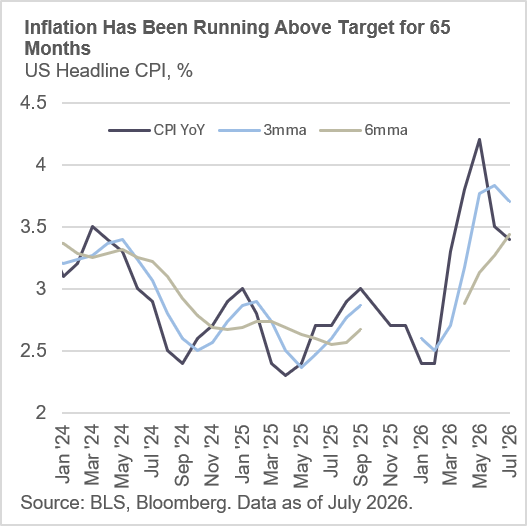
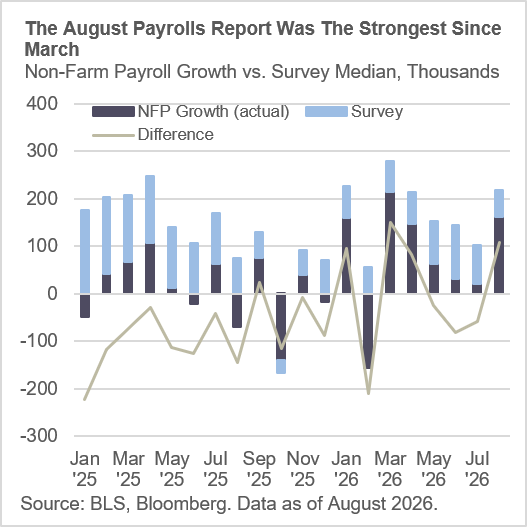
The July FOMC meeting ended with three dissents in favor of a hike, the first three-voter hawkish split since September 2016. Six weeks later, the data has moved in the dissenters' favor. August payrolls rose 162,000 against a 55,000 consensus, the best print since March, with June and July revised up a combined 55,000. Additionally, Chair Warsh used his August 28 Jackson Hole address to go further than he had at any point since taking the job. He said the Fed's "predominant focus right now should be on prices," put the responsibility for "65 months of sustained, elevated inflation" squarely on the central bank, and laid out a standard: the Committee must be confident inflation is moving to target "clearly and at sufficient speed. Otherwise, we have work to do." On the employment side, he said labor markets are "consistent with full employment," which takes away the other reason to wait.
Markets initially read Warsh as the chair who would lean easier. The "regime change" language and the five task forces are still there, but Jackson Hole added the parts that matter for September: a named gauge, ownership of the inflation record, and a view that policy is not currently restrictive. He again declined to offer forward guidance, saying he is "committed to a discipline, not to a decision."
The administration is pushing the opposite way. Trump told Warsh to "get smart" and cut rates in a September 4 Truth Social post, then escalated two days later, threatening to halt trade with deficit countries and citing the Supreme Court's tariff ruling as his authority to do it, with Vance and Bessent echoing the call for lower rates within the same week. Warsh has said the president has had no impact on his decisions and has pointed to the July hold's three dissents as evidence. A hike here reads as independence holding; a hold without a soft CPI print to justify it may read as the pressure working.
A soft August CPI print, particularly a downside surprise on core, gives the Committee cover to hold. Anything at or above consensus, on top of the payroll beat and the tone out of Jackson Hole, takes away the last argument for waiting. The bond market has already done some of the repricing: futures markets are pricing a ~60% probability of a hike and the 30-year touched its highest level since 2007 in August before Treasury's expanded buyback pulled it back. With Warsh saying credit and loan markets show "few signs of policy restraint," and that he would be "hard pressed to describe broad financial conditions as restrictive," it is harder to argue 25bp does real damage to growth.
The bigger question is not September. It is whether 25bp does anything about what Warsh now calls 65 months of elevated inflation, or whether it turns out to be the first of several.
Market Signals:
The labor market stopped making the case for a hold. August nonfarm payrolls rose 162,000 versus a 55,000 consensus, unemployment held at 4.1%, and labor force participation ticked up to 61.6% from 61.4%. Average hourly earnings rose 3.1% year-over-year. A weak payroll number was one of the few arguments left for patience, and it didn't show up.
Inflation is the swing factor, and August CPI is the last data the Committee sees. July core CPI ran 2.5% year-over-year while core PCE held at 3.3% and headline PCE firmed to 3.7%, an unusually wide gap that the Fed's preferred gauge has not closed. Warsh made a point of the six-month PCE change running at 4.1%, faster than the 12-month, and of breadth: 54% of the PCE basket is rising more than 3% a year, against 32% in the two decades before the pandemic. The August CPI report lands September 11, five days ahead of the decision, and will be the in focus inflation data point the Committee sees before it votes. Street forecasts still have 2026 core PCE ending the year near 3.2%, consistent with a Fed that sees limited room to wait.