FOMC Preview
The Rithm Take
The FOMC will meet on July 29th to set interest rates, which will be Warsh's second meeting as Chair. Futures markets are pricing roughly a 20% chance of a rate hike, and this meeting will not have a Summary of Economic Projections (SEP) or a dot plot.
Since the last FOMC meeting in June, Chair Warsh has given his testimony to Congress and announced the members of the five task forces.
Bottom Line: The setup into the July 29 FOMC favors a hold. Inflation data cooled more than expected, payroll growth stalled, and Warsh used his first congressional testimony to signal patience over urgency. The real story of this meeting is not the vote. It's how Warsh manages to build the institutional architecture for the framework changes he's promised.
Market Signals
Inflation cooled, but the composition matters. June CPI fell -0.4% month over month, the largest decline since 2020, pulling the annual rate to 3.5% versus consensus near 3.9%.
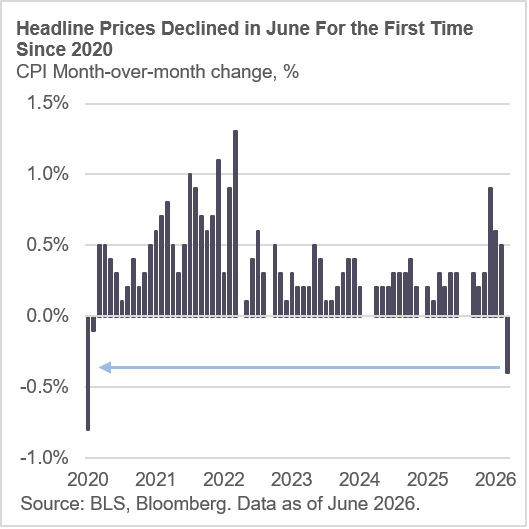
Core CPI came in flat on the month and eased to 2.6% year over year from 2.9% in May. The relief was concentrated in energy, where prices dropped sharply following the Iran ceasefire and Hormuz reopening, and in softer shelter and transportation services. Warsh's own reaction, that this isn't "mission accomplished," signals the Committee still wants to see the softness persist before treating it as a trend.
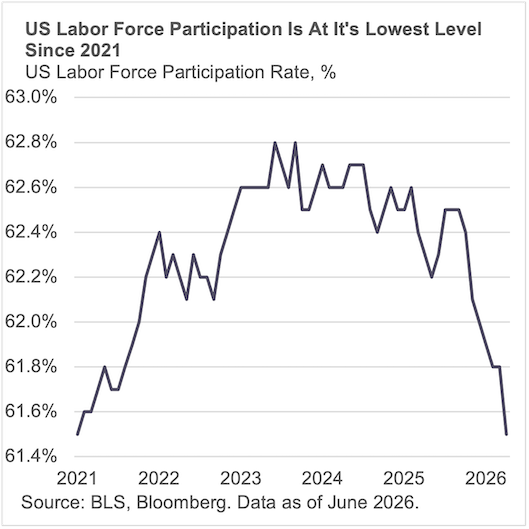
The labor market lost momentum. Nonfarm payrolls rose just 57,000 in June, well short of the roughly 115,000 consensus, with April and May revised down a combined 74,000. The unemployment rate ticked down to 4.2%, a twelve-month low, but the improvement came from a 0.3 percentage point drop in labor force participation to 61.5%, the lowest since March 2021. That matters for how the Committee weighs the employment side of the mandate against still-above-target inflation.
Warsh is building institutional cover for a framework shift. His semiannual testimony before the House Financial Services Committee on July 14 and the Senate Banking Committee on July 15 leaned on "regime change" language, explicit criticism of the 2020 flexible average inflation targeting framework, and a pledge of "no tolerance for persistently elevated inflation." The five task forces, covering communications, balance sheet policy, economic data, productivity and jobs, and inflation frameworks, formalize that agenda and put credentialed economists and former central bankers in charge of the review.
Without updated dots or forecasts, the July decision and statement language carry more weight than usual as the sole signal of the Committee's reaction function until the September SEP meeting. Markets will be parsing Warsh's press conference (if he elects to do one) for any deviation from the June tone rather than for a new numerical anchor. That raises the stakes on word choice, particularly around whether "further adjustment" language reappears.