Five Forces Repricing the Long Bond
Treasury yields are rising for structural reasons, not a single shock.
Borrowing costs for the US government have risen across the curve in 2026, with intermediate and long maturities touching multi-decade highs. The 10-year Treasury has traded above 5% in September while the 30-year breached 5.3% -- the highest level for both since 2007.
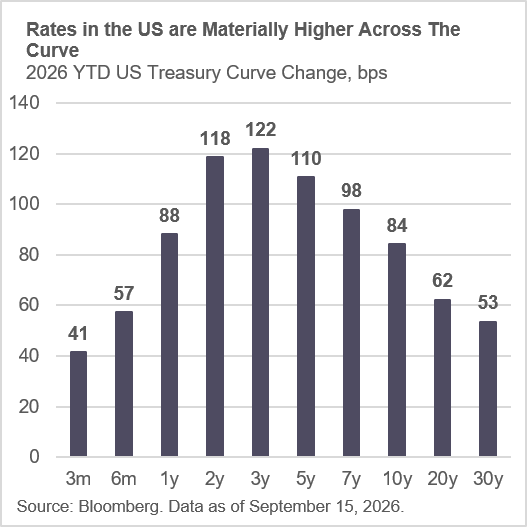
Five forces explain the move: a deteriorating fiscal picture, an oil shock now trading in lockstep with the long end, record corporate issuance competing for the same buyers, growth running hotter than expected, and foreign demand thinning at the margin.
Bottom Line: This is a structural repricing of the cost of capital, not a technical dislocation, and it should be treated as durable rather than faded.
Market Signals
1. The fiscal picture continues to deteriorate. The national debt crossed $40 trillion in August, arriving roughly two years ahead of the pace the CBO itself projected as recently as 2023, when the agency had the milestone penciled in for fiscal year 2028. Total debt now exceeds the size of the entire US economy, a ratio the country has matched only once before, during World War II.
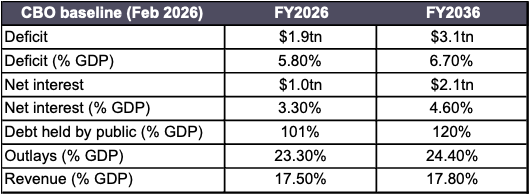
Treasury is managing roughly $30 trillion of marketable debt on which the average interest rate has climbed to 3.41%, up from 1.47% just five years ago. Every one percentage point of increase on that average rate adds approximately $310 billion to annual interest. Net interest already absorbs close to 14% of federal outlays and roughly 19% of revenue, and at 3.3% of GDP it exceeds the post-war high set in 1991. The CBO's baseline has that burden nearly doubling again over the next decade, from $1.0 trillion to $2.1 trillion by FY2036, as the deficit itself widens from $1.9 trillion (5.8% of GDP) to $3.1 trillion (6.7% of GDP). None of this requires a recession or a policy mistake. It's the current-law baseline, and it's the backdrop against which every Treasury auction now clears.
2. Oil and the 10-year have become unusually correlated. The one-month rolling correlation between WTI and the 10-year Treasury yield has climbed to 0.70, more than double its two-year average of 0.3. Since the Iran conflict began in late February, when the 10-year yield was still below 4%, the yield has risen more than 100 basis points in near lockstep with crude, which has moved from the $60s to above $100 a barrel over the same stretch. Diesel, the fuel that moves freight and much of the real economy, has topped $6 a gallon.
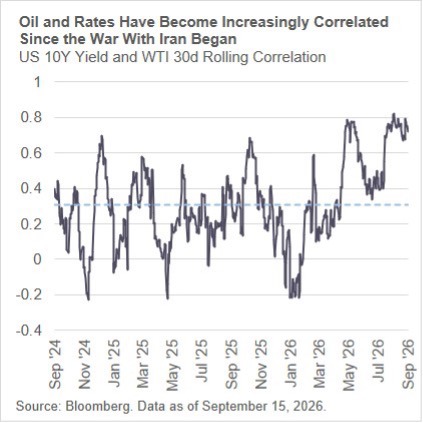
As long as oil and the 10-year keep moving this tightly together, further escalation in the Middle East is one of the more direct paths to a 5%-plus 10-year, and a genuine de-escalation is one of the more direct paths to relief, largely independent of what the Fed does.
3. Corporate issuance is competing with Treasuries for buyers. US investment grade gross issuance has reached $1.91 trillion year-to-date, up 26% from the same period in 2025 and roughly 40% from 2024, putting the market on pace for a record year.

Technology's share of that issuance has more than doubled since 2024, from 5.0% to 12.0%, and hyperscaler borrowing across Amazon, Alphabet, Meta, Oracle, and Microsoft has added $157 billion this year on its own.
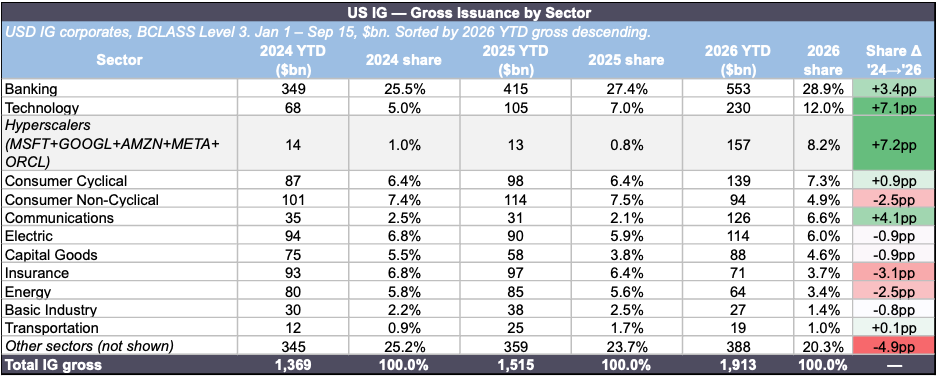
The new supply is heavily weighted toward long maturities, the same part of the curve where Treasury needs its own buyers for 20- and 30-year debt. Every incremental dollar of long corporate paper is a dollar of investor demand that could otherwise have gone into long Treasuries, and issuers are choosing to lock in that funding now rather than wait. That's a durable source of competition for duration capital, not a cyclical one.
4. Growth is running ahead of expectations. The Atlanta Fed's GDPNow model puts third-quarter growth at 4.4%, nearly triple the second quarter's 1.5% pace. ISM Services PMI came in at 55.4 in September, beating the 54.1 forecast, while retail sales rose 5% year-over-year in August. Corporate earnings have confirmed the strength directly: second-quarter S&P 500 profit growth ran near 32% even after stripping out one-time mark-to-market gains at Alphabet and Amazon, the strongest pace since 2021, with 86% of companies beating estimates, also the highest rate since 2021.
The market is pricing that strength directly into real yields, not just growth expectations. A 10-year TIPS auction in July priced at a real yield of 2.438%, the highest for that maturity since October 2008. Stronger growth gives investors less reason to accept a low real return for locking up capital for a decade.
5. Foreign demand is thinning, not just diversifying. Global 30-year yields are up across every major developed market in 2026. France's 30-year yield has touched its highest level since before the 2008 financial crisis, Germany's 30-year bund yield hit its highest since 2011, and Japan's 10-year reached a 30-year high. Japan's move is worth flagging specifically: it remains the largest foreign holder of US Treasuries, and as JGB yields climb to levels domestic investors haven't seen in decades, the carry trade that built that position has less reason to exist. Japan's Treasury holdings have already fallen from a recent high near $1.24 trillion in February to $1.19 trillion in March.
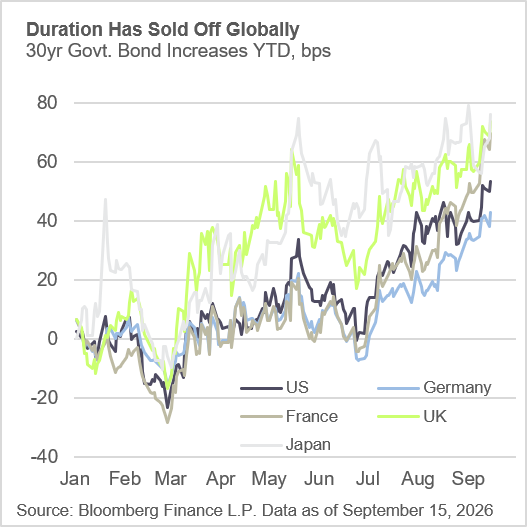
When yields rise everywhere at once, US Treasuries lose some of their relative appeal as the default safe-haven allocation, and foreign buyers who have historically anchored demand have more competing places to put capital.