Q3 Bank Earnings: Clean Credit, Market-Dependent Growth
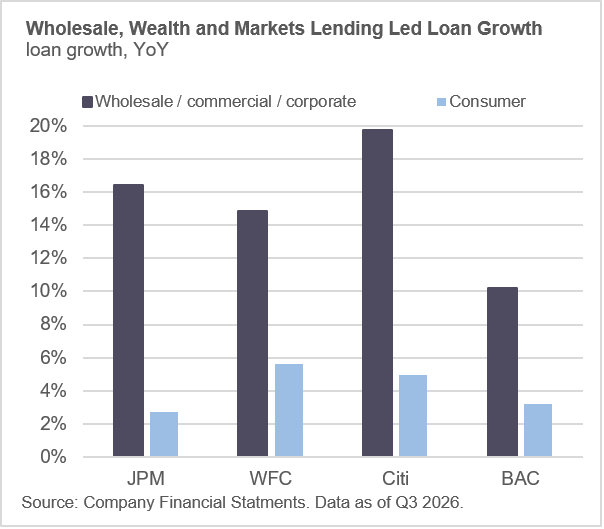
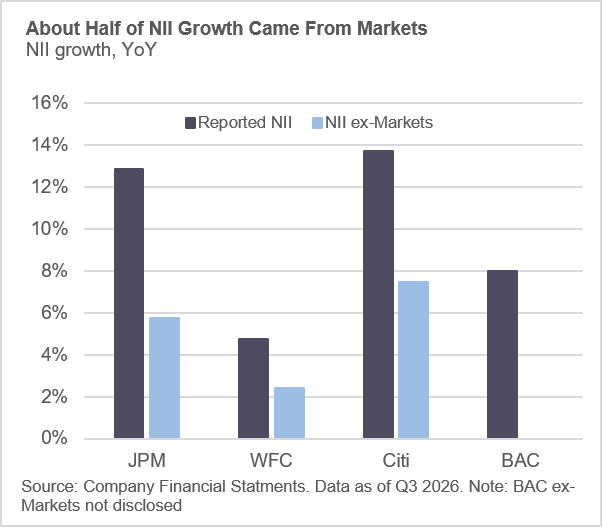
Bottom Line: Bank growth is concentrating with institutions, trading clients and wealth clients, while consumer credit stays healthy. Loans grew about 10% in the third quarter, with wholesale lending supplying more than three quarters of the dollar growth at each bank. About half of net interest income growth at the banks that disclose it came from financing for the markets business. For banks this cycle, the swing factor in earnings is market conditions, not household credit.
Banks are lending where the collateral is financial assets and the borrowers are institutions. Loans at JPMorgan, Wells Fargo, Citigroup and Bank of America grew 7% to 12%, and wholesale lending supplied 77% to 88% of the dollar growth, against consumer books growing 3% to 6%. Inside wholesale, growth sat closest to markets and wealth. Markets loans account for about 63% of Citi’s growth. JPMorgan’s large corporate and investment banking loans rose 27% while Commercial Banking rose 3%. Wells Fargo’s loans to nonbank financial companies rose 27%. Bank of America’s growth was broader across commercial clients.
The same pattern shows up in earnings. Net interest income growth of 5% to 14% at JPMorgan, Wells Fargo and Citi falls to 2% to 7% excluding Markets, so about half of the increase came from the markets balance sheet. That business earns a thin spread and is driven by financing for trading clients, with Citi’s prime balances up more than 40%. Record net interest income therefore depends on market activity and on clients’ willingness to run leverage, which makes it more cyclical than the label suggests.
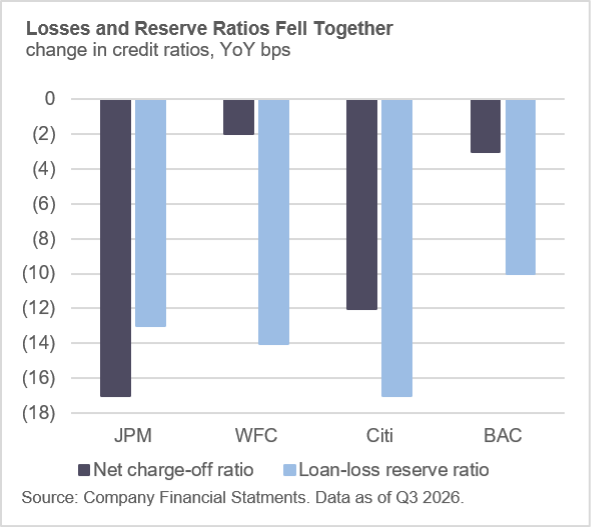
Consumer credit is the quiet part of the quarter. Card loss rates fell 24 to 39 basis points at all four banks and delinquencies were steady to lower. Reserves have followed losses down, with loan-loss reserve ratios 10 to 17 basis points lower at every bank. That is reasonable while losses fall, but it leaves a thinner cushion if they turn. Where banks did build reserves, JPMorgan in wholesale and Citi in cards, they pointed to the macroeconomic outlook, which is a judgment about the future that realized losses have not yet confirmed.
Rates show up in capital and in management language. Unrealized losses on securities widened by roughly $12 billion at JPMorgan and $8 billion at Wells Fargo, and JPMorgan cut gross repurchases to $1.1 billion from $6.7 billion. Both CEOs described healthy customers and still listed higher rates and inflation among their risks.
For banks this cycle, the swing factor in earnings is market conditions, not household credit. The fastest-growing parts of the balance sheet are also the ones most exposed if volatility returns, and financing demand and the spread banks earn on it are what we will track.