October 28th FOMC Preview
The Rithm Take
The FOMC meets October 27 to 28, Warsh’s fourth meeting as Chair and the first since September’s unanimous 25bp hike to 3.75% to 4.00%. Futures price a hold at roughly 85%. The meeting that sets the rate path is December.
Bottom Line: The base case is a hold on October 28. September’s hike bought the Committee time, and the September projections give it a defensible reason to use it. The hold carries real risk because the Chair does not guide. After the July meeting, markets read his silence as a pass on September, and the Committee hiked.
September payrolls rose 29,000 against 84,000 expected, and revisions removed 60,000 jobs from July and August. The unemployment rate rose to 4.2% on higher participation and has held between 4.1% and 4.3% since March. With payroll growth averaging 45,000 a month over the past year, the economy needs fewer jobs to hold the rate steady. As such lower payrolls growth carries less weight when the breakeven figure has downshifted.
Inflation argues for patience running out. September CPI rose 0.6% on the month and 3.7% on the year. Gasoline rose 9.1% and supplied about half of the monthly gain. Core CPI rose 0.3% against 0.2% expected and reached 2.6% year over year from 2.4% -- an indication that elevated energy prices may be seeping into other parts of the economy. Producer prices confirmed the pressure, with core PPI up 0.6% against 0.4% expected. Both core misses sat within one standard deviation of normal monthly noise, which may give the Committee room to wait.
The September projections frame the decision. A 0.5% rise in September PCE would put headline PCE at a 3.9% annualized pace since the fourth quarter, above the 3.7% median projection. A 0.3% core reading would put core at 3.2%, below the 3.4% median. Headline runs above the projection and core runs below it, which fits Warsh’s comment in Bangkok that data since September have broadly met the Committee’s expectations.
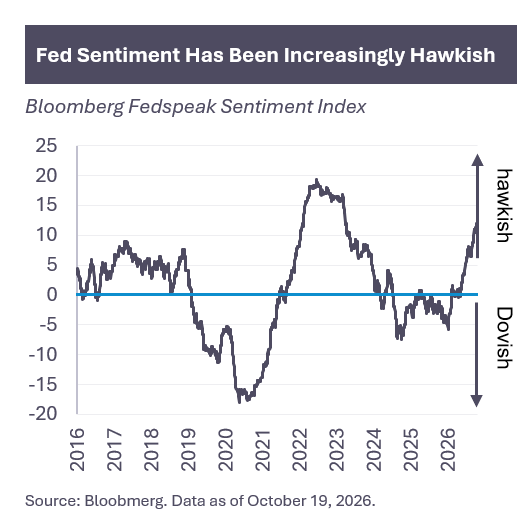
While Fed speak has leaned hawkish as of late, notable exceptions since the September meeting include Vice Chair Jefferson, New York Fed President Williams and Governor Waller each implying the Committee need not hike at back-to-back meetings. Warsh offered no signal on October, saying “I don’t prejudge meetings,” and described the AI investment surge as a demand shock that lifts prices before it lifts productivity. He added that two meetings remain this year and that he will make judgments at them. No first-tier data and no Fed speakers remain before the decision, so pricing will not move.
The Fed is not one-and-done, and the path runs toward further removal of accommodation. Demand supports that path. Capital goods shipments plus net imports ran 41.6% above a year earlier in the third quarter, up from 27.5% in the second. September retail sales rose 6.2% year over year. Nominal consumption plus investment is growing at an estimated 6.75% to 7%, against roughly 5% consistent with 2% inflation. Soft payrolls and strong spending coexist because the spending is concentrated in AI-related equipment.
Market Signals:
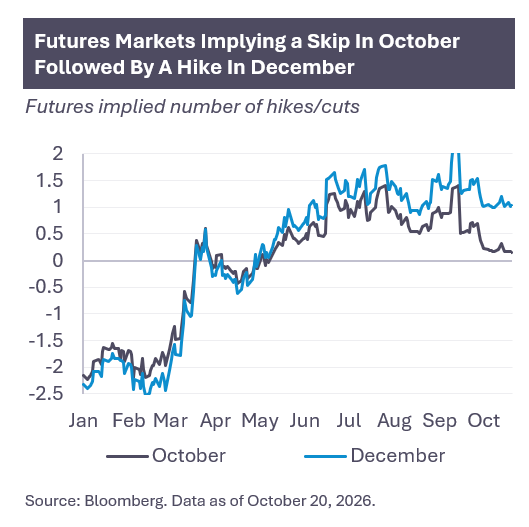
An October hike is priced ~15%, down from about 50% immediately after the September CPI release. A December hike is priced as a sure thing.
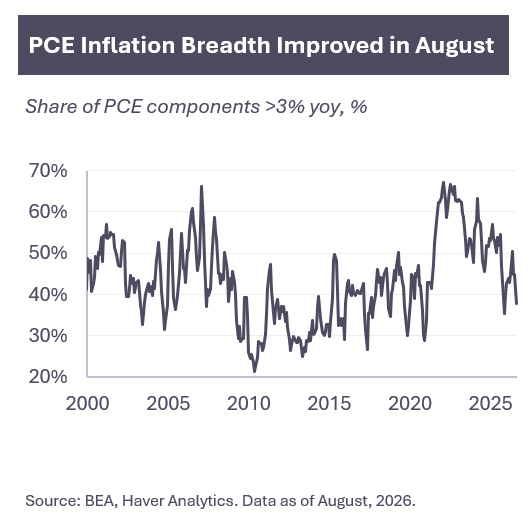
Inflation breadth. Warsh has pointed to breadth as a gauge of whether inflation is moving to target. At Jackson Hole he cited 54% of the PCE basket rising faster than 3% a year, since then that figures has slowed to 34%.