Post Midterms: Mark-to-Market
The Rithm Take
Bottom Line: Democrats control Congress on a mandate of affordability and accountability. Trump keeps the veto. Influence runs through oversight, state policy and fiscal deadlines, and each one could raise the cost of capital. The AI buildout already under construction likely continues. Warren turns Senate Banking into an oversight engine with a credit card cap on the table. Housing policy keeps running through the executive branch. The debt limit hands Democrats a Medicaid trade that could keep rates pointed higher, which could leave the lower-end consumer with steadier coverage but a higher cost of credit.
What happened? Democrats won both chambers on Nov. 3, ending unified Republican control. Democrats flipped at least seven seats in Kansas, Iowa, Texas, Ohio, Maine, North Carolina and South Carolina, including a state that has not elected a Democratic senator in nearly a century.
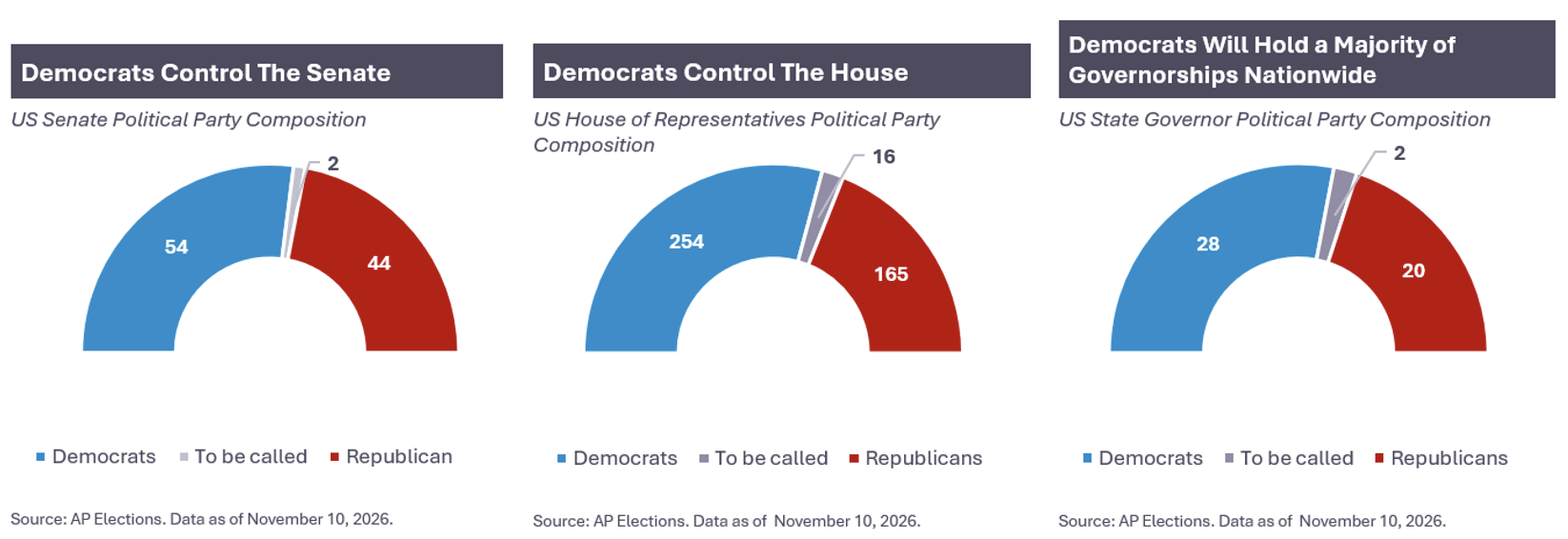
The message was affordability. Democrats campaigned on costs, and the Iran war and concern over data center buildout sharpened the case. The wave reached statehouses too. Democrats flipped at least five governorships, largely in states Trump carried in 2024.
What does it mean? Democrats can slow, scrutinize and bargain. They cannot enact. Here is where the power sits:
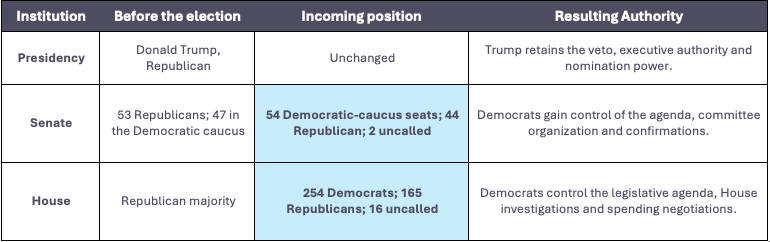
- Confirmations: A simple majority confirms or rejects nominees. Democrats can block Trump picks, including Fed governors and financial regulators, without Republican vote.
- Oversight: Committee chairs gain subpoena power and control of the hearing calendar. Investigations of the administration, Big Tech and Wall Street could begin as soon as January.
- Spending: Government funding and any debt limit increase need House passage and 60 Senate votes. Democrats cannot pass them alone.
- Legislation: Ending debate takes 60 votes, so 54 Democrats need six Republicans. Anything that passes still meets the veto, unless the President agrees, as he has on a credit card interest cap. An override takes two-thirds of both chambers.
- States: New Democratic governors control permits, utility regulators and tax incentives. No veto applies there.
Washington will be in gridlock while the states and the committee rooms move. That is where the market impact begins.
What is the impact?
AI buildout: 2027 is grandfathered, the rest negotiates.
Texas, Georgia and Ohio hold 130.5 GW of planned and under-construction capacity. That is about 38% of the 345.9 GW US pipeline, and Texas alone holds 93.1 GW. Most of it is likely not exposed. Campaign proposals apply pauses to new approvals, which would leave projects already permitted and under construction in place. The exposure is the 60+ GW nationally that has yet to break ground, with Texas holding about 30% of it.
Governors hold real power. They control permitting, tax incentives and the utility regulators that set power terms. In Ohio and Georgia the posture is a negotiation, with a conditional moratorium in Ohio and a temporary pause in Georgia. In Texas the incoming governor ran on a halt to new projects and an end to tax breaks. The asks are that developers fund their own power, hire local labor and share the benefit with host communities. The buildout is the leverage, and the governors want a cut for their states.
The cost scales with how far a project has progressed. Later approvals, new conditions and thinner tax breaks mean a longer timeline and a higher cost per megawatt for projects still waiting. The risk concentrates in leveraged developers that need new power, while hyperscalers with capacity in place held up relatively better in the post-election selloff.
Warren at the helm of Senate Banking.
Warren is widely expected to chair the committee, with subpoena power over banks, the Fed, housing finance and crypto. Affordability leads her agenda, and a 10% credit card interest cap is the centerpiece. Trump proposed a one-year 10% cap in January and Warren backed it, but it never became law. Senate Republicans warned it would deprive many people of access to credit. Banking groups make the same argument, that a cap would reduce credit availability.
With Democrats holding the gavels, the cap can move. A presidential endorsement is the rare path past the veto. Lower-income borrowers gain from cheaper credit, but lenders could pull back from the same borrowers. Her team also flagged AI, prediction markets and financial stability as priorities. The committee runs Fed confirmations too, which routes the Fed’s personnel fight through the committee.
Housing and the consumer: the levers sit at the White House.
Housing policy is unlikely to shift in a meaningful way. Most of the administration’s action has run through the executive branch rather than in close coordination with Congress. Changes to title, credit scores and streamline refinancing at the GSEs can all be made by FHFA in coordination with the CFPB. More congressional oversight may slow the pace at the agencies, but most of the levers at the GSEs, HUD and the VA still rest with the White House. An existing executive order directs FHFA to consider lower loan-level price adjustments for title-waiver loans. That could cut refinancing friction and raise the value of the prepayment option for servicing and agency MBS holders.
The CFPB is the near-term tell. Brian Johnson, the director nominee, advanced out of the Banking Committee 13-11 along party lines in September, and the lame-duck Senate, still under Republican control, is the last window to confirm him before Warren holds the gavel. A quick vote could show agency priorities, and he is widely expected to curb enforcement and reduce regulations. GSE privatization comes up occasionally in remarks from the FHFA Director and the Treasury Secretary and could proceed by executive action. But, the groundwork has not been laid, and conviction appears thin.
Debt limit: the health care trade.
The limit sits at $41.1 trillion and Treasury likely runs out of room to pay its bills in late 2027, while government funding expires Dec. 11. That gives Democrats a must-pass bill that needs their votes. Their target is Medicaid.
The 2025 reconciliation law cut federal Medicaid spending by more than $900 billion over ten years per CBO estimates. A full reversal runs about $90 billion a year against a deficit near $2 trillion. The likely deal is smaller, but the direction matters more than the size. Divided government blocks tax cuts and blocks consolidation, so any restoration adds to a deficit with no offsetting plan. The brinkmanship can add term premium of its own. Markets first read divided government as fiscal restraint. However, the debt limit negotiations may say otherwise.
The lower-end consumer: steadier balance sheet, costlier credit.
Medicaid protection keeps health coverage in place for lower-income households, which lowers the odds that a medical bill becomes a missed payment. The fiscal path that funds it could also push rates higher, pricing some of the same households further from a mortgage and weighing on origination volumes. A credit card cap adds tighter card credit, with banking groups warning it would push consumers toward less regulated, more costly alternatives. The lower-end borrower could end up with a steadier balance sheet, tighter card credit and a higher mortgage rate.
The midterms shift leverage without shifting the veto. AI keeps building, on new terms. Intermediaries face more scrutiny. Housing policy keeps running through the White House. Treasury supply picks up a political calendar.