GSE Buying: Not QE, but Not Nothing
The Rithm Take
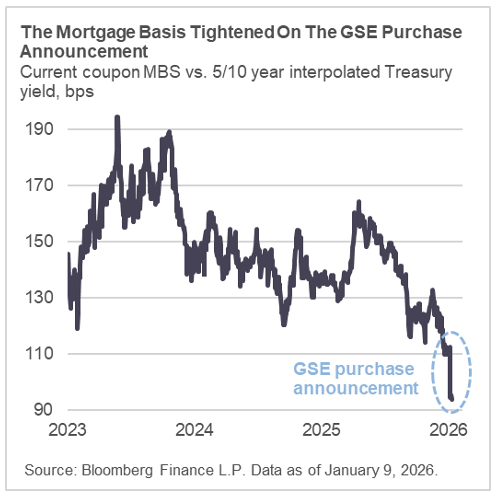
The market’s reaction to the Administration’s announcement that the GSEs could purchase up to $200 billion of agency MBS was swift. Production coupon spreads entered the year at ~120bps; immediately following the announcement, they tightened to ~90bps before giving up some gains. In headline terms, the response made sense – a large, policy-directed buyer entering the market and purchasing a meaningful share of forecasted annual supply.
With this announcement, the direction of travel is clear. The Administration will look to exercise all levers to ease affordability. These purchases stand to offset the Federal Reserve’s runoff of Agency MBS. By resetting tighter the spread on benchmark Agency MBS, the cross over impact is setup to ripple across residential credit, securitized and asset-based finance products, to ease broader financial conditions.
This tightening matters for affordability. Mortgage affordability has only three durable levers: lower home prices, higher household incomes, or lower borrowing costs. Home price declines are economically and politically undesirable, while income support has already been addressed through fiscal channels, including OBBA. That leaves mortgage rates as the remaining lever—and agency MBS basis tightening is one of the few mechanisms capable of influencing them.
Structurally, however, this is not QE. The tightening we have seen reflects a one-time flow shock being rapidly discounted, not the start of a durable, price-insensitive demand regime. Still, even a one-time tightening in the mortgage basis can translate into, real-world rate relief for borrowers, particularly at a time when affordability remains historically stretched. Once the initial compression is absorbed, the reality around funding, economics, and portfolio governance reassert themselves in ways that materially differentiate GSE buying from Fed balance sheet expansion.
On balance, the announcement explains the move we have already seen. It can plausibly support affordability by tightening the basis and pulling primary mortgage rates lower. It does not, however, justify extrapolating materially tighter levels from here without assuming a policy shift that would require explicit changes to the GSE framework.
Market Signals
The tightening has largely occurred
Production coupon spreads settled by roughly 15 basis points since the announcement, consistent with estimates that a one-time $200 billion purchase could compress spreads by 10–25 basis points. In other words, the mechanical impact has been realized, and with it the bulk of the near-term rate transmission.
GSE balance sheets were already expanding
Fannie and Freddie had been growing portfolios ahead of the announcement, adding roughly $55 billion in the period from May through November last year. The surprise was not direction, but magnitude and timing, which amplified the near-term tightening impulse.
Scale matters—and this is small relative to QE
At $200 billion, the program is an order of magnitude smaller than prior QE episodes, which ran over $1 trillion during COVID and were explicitly open-ended. GSE capacity is finite. This limits how far basis tightening—and therefore mortgage rate relief—can extend absent further policy action.
Supply absorption shifts, not disappears
The program reduces the amount of net supply money managers must absorb, but it does not eliminate the need for private capital. That said, even partial absorption can lower clearing spreads and support mortgage rates in a market where affordability is highly rate-sensitive. That distinction becomes increasingly important once relative value normalizes.
The Conversation
The market is reacting to flows, not permanence.
A $200 billion buyer arriving faster than expected will tighten spreads. That does not make the buyer equivalent to the Fed. QE worked because it combined three features simultaneously: indefinite duration, total price insensitivity, and reserve creation that pulled banks into the bid. None of those fully apply here. But unlike QE, the policy objective here is narrower: easing financing conditions at the margin rather than reshaping the entire rate complex.
Funding is the first constraint. Historically, GSE portfolio growth has been funded through debt issuance. Growing portfolios by $200 billion will almost certainly require additional agency debt supply, with PSPA caps and debt limits acting as binding constraints unless revised by agreement between Treasury and FHFA.
Economics are the second constraint. OAS on par coupons is now pricing between -10 and +10 basis points. Sustained buying at those levels is difficult to reconcile with any credible path toward running the GSEs “like a business,” a stated objective of the Administration. Still, from an affordability perspective, even short-lived non-economic buying can compress primary mortgage rates enough to matter for marginal borrowers. Hedged purchases, duration-gap management, and volatility hedging all reduce the effective aggressiveness of the bid relative to the Fed’s historical approach.
Market structure is the third constraint. While tighter spreads can lower mortgage rates at the margin, the effect is inherently self-limiting. As financing costs fall, refinancing and transaction activity tend to pick up, which naturally increases supply and reduces the incremental impact of further tightening. This dynamic allows for near-term affordability relief, but it also prevents the adjustment from becoming permanent without additional policy support.