Building the Case for Consumer Convergence
The Rithm Take
The Bottom Line: The July payroll print looks soft, but small-business hiring intentions and a construction sector pivoting toward AI infrastructure both point to strength building underneath the headline. That strength is landing first as wage gains for lower- and middle-income households, which is closing in on the prevailing K-shaped consumer gap from the bottom up.
The July jobs report gave bears a headline. Payrolls fell 23k. Markets marked down Fed hike expectations on the print.
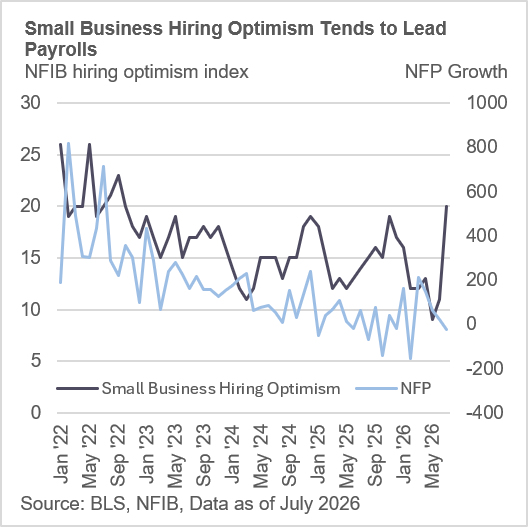
Small business tells a different story, and the timing of that story matters. The NFIB Small Business Hiring Optimism Index has historically led payroll growth by roughly two-to-three months.
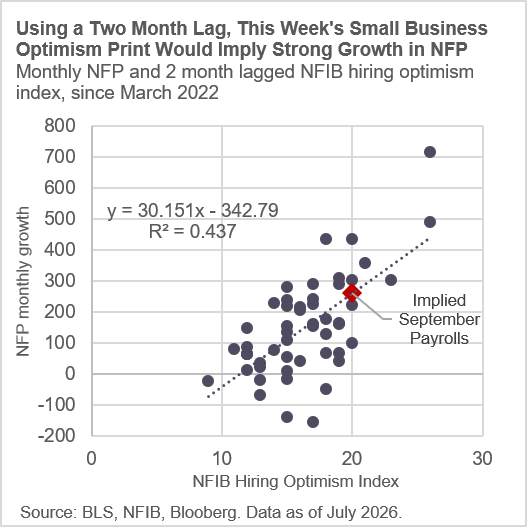
Regressing monthly NFP growth against a two-month-lagged hiring optimism reading since March 2022 produces a meaningful positive relationship. Applying that relationship to the latest hiring optimism print implies a materially stronger payroll number for September than July's -23k reading.
Small firms employ roughly 62 million people and generate close to 44% of GDP. One place that forward-leaning strength is already showing up in hard data, not just a leading indicator, is construction. Nonresidential building jobs have been steadily gaining share against residential building jobs since 2022, the same year generative AI moved from research curiosity to commercial mainstream, and the two lines continue to diverge in 2026.
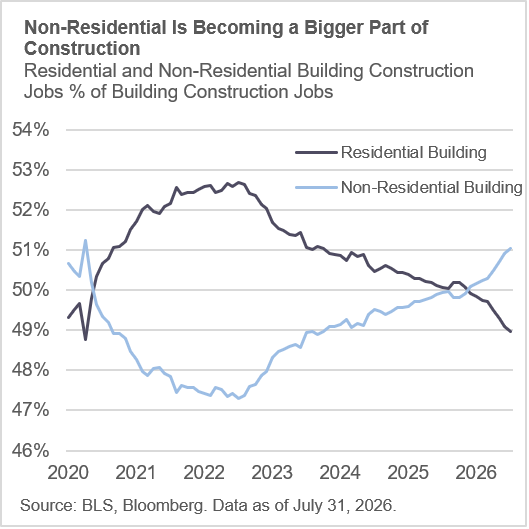
That shift is likely driven by the AI capex and data center buildout, which has created sustained demand for the kind of blue-collar construction labor that used to track the housing cycle almost one for one. Construction employment is no longer just a housing story. It is increasingly an AI infrastructure story, and unlike the NFIB signal, it is already visible in realized employment data rather than implied by a lagged relationship.
That composition shift matters for the consumer, because it links directly to the K-shaped question. The divide between high- and low-income spending has defined the last two years. It has been closing since May, and the gains are wage-funded rather than credit-funded. Lower-income after-tax wage growth outpaced higher-income wage growth in July for the first time since December 2024.
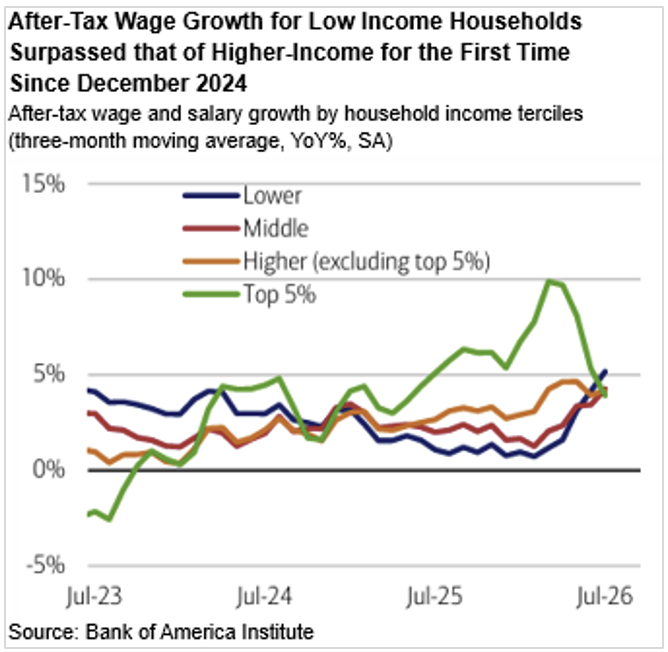
A construction sector reallocating jobs toward nonresidential, AI-linked buildout is a plausible channel for exactly that kind of wage gain, since construction labor skews toward the lower- and middle-income cohorts that are doing the converging.
Wage-funded convergence is a durable channel, and the credit data backs that up on two fronts. Full credit card payoff rates are rising across every income cohort, and savings balances remain elevated with no sign of drawdown. Separately, the New York Fed's Q2 report shows total household debt actually declined slightly, and the flow rate into serious delinquency, the measure of new households falling behind right now, has been flat for almost two years. The more alarming stock delinquency numbers circulating in the press are driven by old, charged-off balances that lenders are simply reporting for longer than they used to. Read differently, households are not falling behind at a faster pace than they were in 2024, as the k-shaped gap converges.
The labor market and the consumer are sending the same signal from different angles. NFIB hiring optimism leads payrolls by two-to-three months, and the current reading implies acceleration ahead. Construction employment is already reallocating toward AI-linked nonresidential building, visible in the data now. Wage data shows the result landing first at the bottom and middle of the income distribution. The K-shaped label was right for the shape of 2024 and 2025. But now, in mid-2026, convergence is happening from the bottom up. That convergence is funded by income and by a construction sector reallocating toward AI infrastructure.